%20(2)_edited_edited_edited.png)
eXciteOSA Review: Daytime Therapy for Snoring and Mild Sleep Apnea
- Emma Mattison

- Jun 15
- 9 min read
eXciteOSA Review: Daytime Therapy for Snoring and Mild Sleep Apnea
If you snore, wake up tired, or have been told you might have mild sleep apnea, you have probably noticed that many common solutions involve wearing something at night.
For some people, that works well.
For others, the idea of sleeping with a mask, mouthpiece, or device every night is a major barrier.
That is why I wanted to introduce eXciteOSA, a prescription, FDA-authorized daytime therapy designed for snoring and mild obstructive sleep apnea.

This is not a magic-fix video, and it is not a replacement for evaluation by a qualified health care professional.
This is a practical look at what eXciteOSA is, who it may make sense for, what the research suggests, and why tracking baseline sleep data matters before starting any therapy.
Quick disclosure: this product was gifted to us by Spring Sleep. They have followed my husband’s sleep issues on this channel, including his trouble sleeping, low deep sleep, and likely upper airway resistance issues. They asked us to test the device for six consecutive months as part of his sleep journey.

If you decide to use my link, it is at no extra cost to you, and I may earn a small commission.
Buy Now: eXciteOSA Starter Pack,
Coupon Code: EMMA15 for 15% off
What Is eXciteOSA?
eXciteOSA is a removable oral device that uses neuromuscular electrical stimulation along the tongue during the day.
Yes, I know it looks a little intense at first glance.

The important distinction is that this is not something you wear while you sleep.
Instead, the standard protocol is 20 minutes once per day for six weeks, followed by maintenance sessions after that.
The goal is to help train the muscles involved in keeping the upper airway more stable during sleep.
That matters because sleep disordered breathing is not always as obvious as people think. Sometimes it shows up as loud snoring. Sometimes it shows up as poor sleep quality, brain fog, lower energy, waking up unrefreshed, or a bed partner noticing that something seems off during sleep.
As a fitness and health professional, I care about this topic because sleep affects recovery, energy, training performance, appetite regulation, mood, and long-term health. You cannot out-supplement or out-exercise chronically poor sleep.
How Daytime Tongue Stimulation May Help Snoring and Mild Sleep Apnea
One of the more interesting parts of eXciteOSA is that it focuses on the tongue and upper airway muscles.
That may sound odd if you have never thought about the tongue as anything more than something involved in speaking, chewing, and swallowing.
But the tongue plays a major role in breathing mechanics. Tongue position, tongue tone, and upper airway muscle function can influence how open or stable the airway remains during sleep.
In some people with snoring or mild obstructive sleep apnea, upper airway muscle endurance may be part of the issue. The concept behind eXciteOSA is to apply daytime neuromuscular stimulation to improve oral muscle function, rather than only trying to manage symptoms at night.
That does not mean every case of snoring or sleep apnea is caused by weak tongue muscles.
It also does not mean a device like this is appropriate for everyone.
Sleep apnea is complex. Anatomy, weight, hormones, nasal breathing, airway structure, sleep position, alcohol use, medications, inflammation, and nervous system factors can all play a role.
That is why I am approaching this as a real-world test with baseline data, not a dramatic before-and-after promise.
Who Might eXciteOSA Make Sense For?
Based on the product information, research, and the kinds of people I work with, eXciteOSA may be especially relevant for a few groups.
First, it may be relevant for people with mild obstructive sleep apnea who are looking into noninvasive options and do not want to wear a device all night.
Second, it may be relevant for people who snore and know their snoring is disruptive, either to their own sleep quality or to their partner’s sleep.
Third, I think this topic matters for postmenopausal women. Snoring, fatigue, and poor sleep can sometimes get written off as “just hormones,” when sleep disordered breathing may also be part of the picture.
Fourth, it may be relevant for people working on weight loss, including some GLP-1 users, who want to improve sleep quality as part of their broader health picture.
That said, if you think you may have sleep apnea, you should talk with your doctor or a qualified health care professional. eXciteOSA is intended for snoring and mild obstructive sleep apnea, and it is prescription-only.
What eXciteOSA Review Is Not
I want to be very clear about expectations.
This eXciteOSA review is not a magic pill.
It is not something I would describe as a blanket replacement for every sleep apnea treatment.
It is not something that should be used as an excuse to avoid medical evaluation if you have symptoms of sleep apnea.
And it is not something where I would expect every person to respond the same way.
The brand describes eXciteOSA as a clinically tested daytime therapy for snoring and mild obstructive sleep apnea. The device focuses on improving sleep quality, reducing snoring, and addressing one possible root cause by supporting oral muscle function.
The brand’s reported proof points include reductions in snoring, reductions in sleep apnea severity for some users, and bed partner-reported improvements in snoring.
Those are interesting claims, but individual response still depends on the person, severity, adherence, airway anatomy, physiology, and whether the device is actually appropriate for that person.
Why Baseline Sleep Tracking Matters Before Starting eXciteOSA
Before starting any therapy, I think it is crucial to have some kind of baseline.
If you do not know where you started, it becomes very easy to overestimate results, underestimate results, or rely on vague memories like, “I think I’m sleeping better.”
For my husband, we are focusing on several baseline markers:
Snoring trends
Sleep quality
Daytime energy
Restorative sleep patterns
Deep sleep
Consistency with the therapy
Because he is already doing a broader sleep series, we have months of sleep-related data to compare against. That gives us a better chance of seeing whether anything meaningful changes over time.
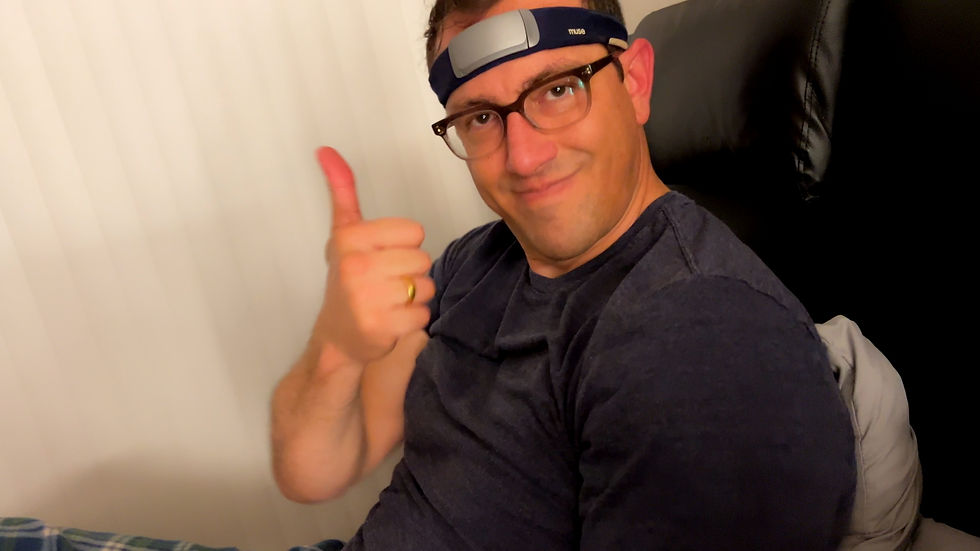
We are also using Muse to track sleep quality more directly. I like this because we are not just looking at total hours in bed. We are trying to understand whether his sleep is restorative.
Hours slept matter, but sleep quality matters too.
For many people, this is where sleep tracking can become useful. Not because wearables or consumer devices are perfect, but because they can help identify trends over time.
Adherence Matters With Daytime Sleep Apnea Therapy
Consistency is going to be a major part of whether eXciteOSA has a fair chance to work.
That is true with fitness.
That is true with nutrition.
And it is true with sleep therapy.
The standard structure is 20 minutes per day for six weeks, followed by maintenance sessions. That sounds simple, but simple does not always mean easy. Any daily behavior still has to fit into real life.
One thing I found interesting from the adherence data is that users still had meaningful adherence even though they did not complete every single prescribed session perfectly.
That is realistic.
In health and fitness, I am always reminding people that consistency matters, but perfection is not the standard. If someone can adhere to a protocol most of the time, that may still be enough to create measurable changes.
Of course, if you are going to test a device like this, you need to give it a real chance.
Doing it randomly once in a while is not the same as following the protocol.
Our First Impressions Using eXciteOSA
The device itself is fairly straightforward once you understand the directions.
The biggest learning curve for my husband was figuring out how to position his tongue correctly, mostly because he has a large tongue. Once he figured it out, he did what many competitive people do and turned the intensity up as high as he could tolerate.

That is not the recommendation, by the way.
But he said it did not hurt.
Since then, he has been using it at a moderate intensity. For him, that seems to be working.
One thing he noticed is that when a session starts, the sensation can feel surprising if it begins near the previous intensity level. His feedback was that he would prefer a more gradual ramp-up because the first sensation can feel a little shocking.
He also noticed tongue soreness after the first session.
To me, that sounds similar to mild muscle soreness, which could make sense if the device is stimulating muscles that are not used to that kind of work. Mild soreness may be expected, but significant soreness or discomfort would not be something I would ignore.
The app itself is simple and helpful. It connects to the device, tracks the session, and clarifies the protocol.
I also appreciate that the app limits the session length. That matters because eager users may be tempted to overdo it in the beginning.

One downside he mentioned is increased salivation. He sometimes has to take the device out and swallow. According to the app and protocol, this may improve as the mouth and tongue acclimate.
His practical warning: do not let it touch your teeth on the way back into your mouth.
Tracking Sleep Quality, Snoring, and Real Results
Over the next several weeks, we will be tracking how eXciteOSA fits into his life and whether there are meaningful changes in the metrics that matter.
For us, that means watching:
Snoring patterns
Sleep quality
Deep sleep trends
Restorative sleep
Daytime energy
Adherence
Subjective feedback
Bed partner observations
I do not want to rely only on “I feel like it worked” or “I feel like it did not work.”
That does not mean subjective experience is useless. How someone feels matters. But I prefer to pair subjective feedback with objective or semi-objective trends when possible.
That is especially important with sleep, because memory can be unreliable. People may not know how much they snore. They may not notice breathing disruptions. They may wake up tired and assume it is stress, hormones, aging, or poor discipline.
Sometimes those factors are involved.
Sometimes, sleep disordered breathing is part of the picture, too.
Should You Try eXciteOSA?
If you snore, have mild obstructive sleep apnea, or wake up exhausted even after a full night in bed, eXciteOSA may be worth learning about.
But this is not a self-diagnosis tool.
If you suspect sleep apnea, talk with your doctor, dentist trained in sleep medicine, or qualified sleep professional. Sleep apnea can have serious health consequences, and the right treatment depends on the person.
For some people, CPAP may still be the appropriate option.
For others, an oral appliance, positional therapy, weight management, nasal breathing support, medical treatment, or another approach may be recommended.
For the right candidate, eXciteOSA may be an interesting option because it is used during the day rather than worn overnight.
That is the main reason I wanted to test it in a structured way.
Final Thoughts on eXciteOSA and Sleep Health
My main takeaway right now is this: sleep disordered breathing deserves more attention.
Too many people normalize snoring, daytime fatigue, poor recovery, low energy, and waking up unrefreshed. Especially in adults over 40, these issues can easily be blamed on age, hormones, stress, or being busy.
Sometimes those things matter.
But sometimes the real issue is that your sleep is not as restorative as you think.
That is why I like the idea of tracking baseline data before starting any intervention.
Whether you are using a device, changing your habits, adjusting your training, or working with a sleep professional, you need to know what you are comparing against.
We are still early in this process, so I am not giving a final verdict yet.
For now, we are getting started, tracking the data, watching adherence, and paying attention to what actually changes over time.
If you want to learn more about eXciteOSA or see whether you may be eligible, you can use my link below.

Buy Now: eXciteOSA Starter Pack,
Coupon Code: EMMA15 for 15% off
If you use my link, it is at no extra cost to you, and it helps support my channel and content.
And always remember, your health is an investment, not an expense.
About the Author

I’m Emma Mattison, a NASM Certified Personal Trainer, Nutrition Coach, and Functional Aging Specialist. I own Emma Mattison Fitness, where I help adults 40+ build strength, improve mobility, support long-term health, and take a practical, science-backed approach to fitness and recovery.
My work focuses on functional fitness and holistic health, especially for people who want to feel better, move better, and make informed decisions about their health without falling for hype. Through my YouTube channel, blog, and coaching, I review health technology, recovery tools, fitness products, and wellness trends with one goal: to help you understand what may actually be useful and what may not be worth your time.
I believe health decisions should be based on education, self-awareness, and realistic consistency, not fear or quick fixes.
And always remember, your health is an investment, not an expense.
References
FDA. Neuromuscular tongue muscle stimulator for the reduction of snoring and mild obstructive sleep apnea.
eXciteOSA. Daytime therapy for snoring and mild obstructive sleep apnea.
Baptista PM, et al. Daytime neuromuscular electrical therapy of tongue muscles in improving snoring in individuals with primary snoring and mild obstructive sleep apnea.
Kotecha B, et al. A novel intraoral neuromuscular stimulation device for treating sleep-disordered breathing.
Signifier Medical Technologies. Real-world adherence to eXciteOSA treatment.
Comments